Wednesday, October 9, 2013

Day 23: Winslow, AZ : 383.7 miles; 5:41.

We started off early at 7:15 and headed towards Albuquerque looking for balloons.  Turns out that the Balloon Fiesta is going on (Oct. 6 - 13).  It is sort of like the Kite Festival in Long Beach, WA.  They have some events each day and then on the last weekend have a "Grand Ascension."  They do their events in the early morning or evening hours.  We saw the local newscaster broadcasting from the launch zone in the morning before we left.  We were hoping that they might still be in the air when we got to Albuquerque.

But we had about 100 miles to cover.  The countryside started out flat.  The monotony was broken by many billboards.  One inviting us to visit the brewery for "Alien Amber" beer.  We ran into some road construction with no workers in sight.  We decided that the only reason for the construction zone, which kept changing the lane closed (right to left) must be to keep people awake at the wheel.

At 7:59, we had our first siting of what we considered "real" mountains on the horizon.  Soon we were in the mountains to the east of Albuquerque and passing into the city.  Albuquerque (pop. 545,852; elev. 4957 feet) is New Mexico's largest city.  It was founded in 1706 as a Spanish colonial outpost and farming community along the Rio Grande.  Jim noted that there were very few high-rises in downtown here and the overpasses were decorated and looked nice.  The houses were all brownish, cream, or reddish and blended very well with the countryside.  It is a very pretty town. We passed some subdivisions that looked like Walter White's home in Breaking Bad.  But sadly, NO BALLOONS.
After Albuquerque, we passed mesa lands which looked like they might have been formed by the Rio Grande.  We passed through Navajo lands and came to a town called Grants (pop. 9,182; elev. 6,450).  A Navajo rancher named Paddy Martinez was curious about a yellow rock he found about 10 miles out of town.  Turns out the rock was uranium and within months the town changed from a farming community to a mining community.  This all lasted until a recession in 1982-83 which forced many of the mines to close.  
The countryside was scenic and colorful.  We passed signs for many National Monuments, which due to the government shut-down are closed now.  The wind was strong and we saw some dust devils.  We saw a sign that said we had crossed the Continental Divide.

We got off the Interstate at Gallup.  Gallup has a population of 21,678 and an elevation of 6,508 feet.
The railroad came to the Gallup region in 1881 to use the regions coal deposits for its engines. At thetime Gallup was a stagecoach stop consisting of a saloon/general store called the Blue Goose.  Gallop is known for coal mining and the railroad, but it is best known as the main trading center for most Navajo as well as nearby Zuni and Hopi wares.  The town has over 100 trading posts.

We got downtown and found it lined with trading posts, pawn shops, and galleries.  I didn't know where to begin, there was so much beautiful pottery, jewelry, rugs, blankets, etc.  Jim found a store he liked and we went in.  We were the only ones in the store and Jim immediately asked the proprietor how we could tell we were buying authentic goods.  We had a good conversation with Mike and he was eager to answer any questions we had.  I found a pot that kept calling to me, so we now have it in a large box in the back seat.  The pot was made by a Hopi artist named Stetsen Setalla.  Mike emailed a picture of the artist holding our pot in his store.  He takes pictures with his phone when the artists bring in their pieces for the store.
There is a Zuni Pueblo 30 miles south of Gallup.  The community has a population of 6,302 and is the only surviving settlement of the "Seven Cities of Cibola" sought by Francisco Vazquez de Coronado in his quest for gold.  It is one of the largest existing inhabited pueblos.  Ancient rites and traditions are still practiced.  You can arrange to visit the pueblo, but no pictures are allowed without a special permit.

We made a rest stop at McDonalds and got back on the I-40 West.  Soon we were in Arizona.  It was very windy.  The speed limit remained 75mph, so Jim was happy.  We passed through the Painted Desert and a sign for the Petrified Forest National Park.  We tuned to 1610 AM for information and the park person told us the park was closed and thanked us for our "understanding."  Jim said, "We don't understand at all."  When we stopped at the Arizona Welcome Center to pick up some maps, an older man was complaining about the Grand Canyon being closed.  He said it was closed unless you broke in at gunpoint.  Seems to me that Congress has grossly underestimated the wrath of seniors who cannot get into the National Parks.

In the distance we saw what looked like clouds.  Turns out it was a giant dust storm.  The wind kept getting stronger and stronger, so we decided to stop at Winslow (pop. 9,655; elev. 4,856).
The town was named after a president of the Atlantic and Pacific Railroad and is a railroad, shipping, and trading center.

We stopped at one motel and they said they were full.  So we went across the street and found a room at the Quality Inn.  I asked the clerk if there was something going on in town.  He said no, that it was probably the wind.  He said they might shut the Interstate down, so folks were stopping early.  He also told me that the nickname for Winslow is "WindsBlow" and that the town had been chosen as the site for an international airport...until they considered the wind.
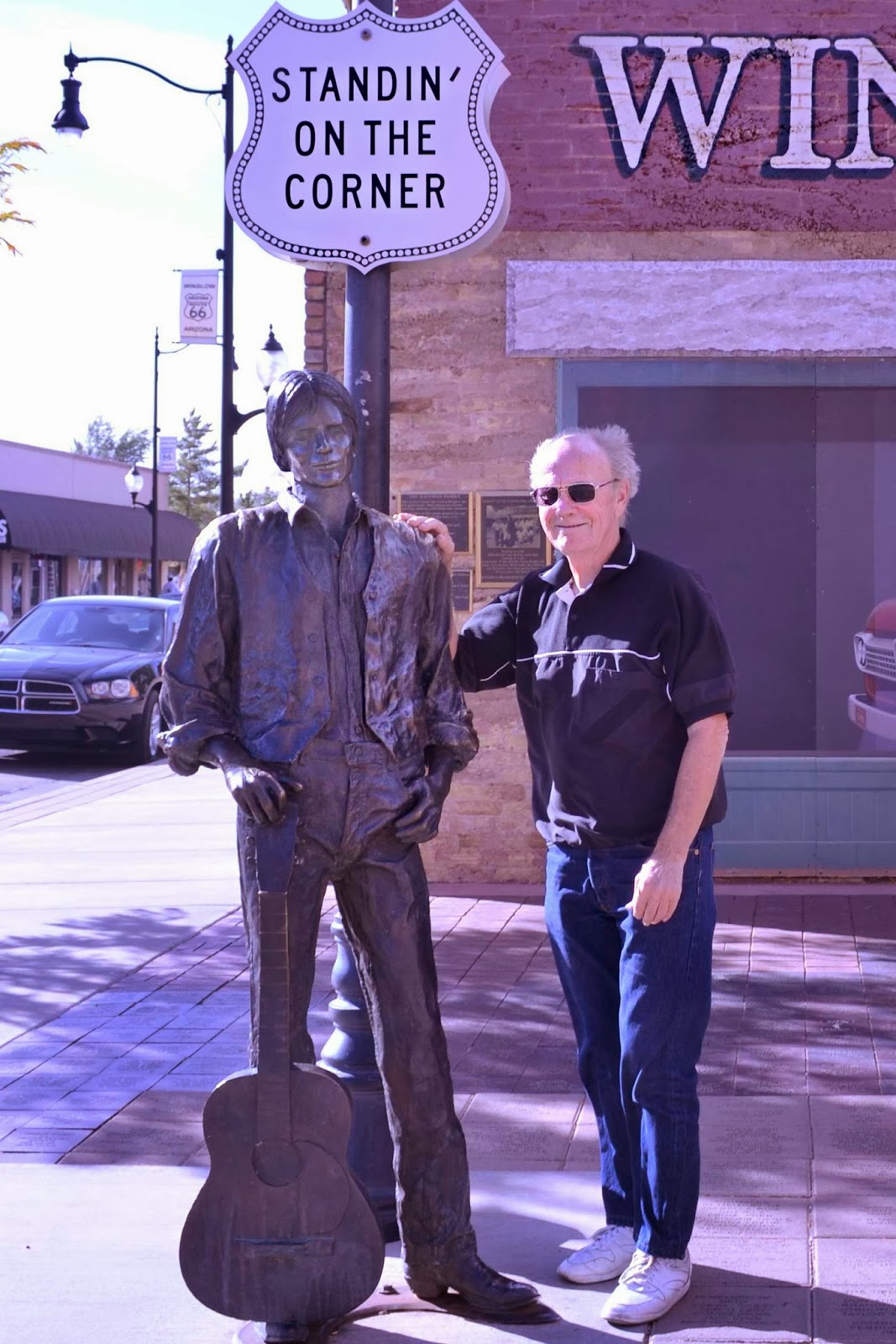
Winslow became known in the 70's from the lyrics of the Eagles first hit single, "Take it Easy."  The verse "Standin' on a corner in Winslow, Arizona" was the inspiration for "The Corner" in downtown Winslow featuring a life-size bronze statue and a two story mural depicting the story behind the famous song.  Winslow is also on "Historic Route 66."  We found the corner and took some pictures.  Notice that Jim's hair is horizontal from the wind.

Another downtown attraction in Winslow is the La Posada hotel restored to look like a Spanish hacienda.
Back at the motel, we watched the local weather and found out that the wind gusts in Winslow (50mph) were the highest in the state.  They also said it might snow tonight in Flagstaff.  Yipes.


Tuesday, October 8, 2013

Day 22: Santa Rosa, New Mexico: 402.3 miles; 5:56.


We left at 9:00 AM and headed down the Interstate for a few miles and got off to see Fort Reno.  After we got off, we didn’t see any signs, just a long road.  Finally we saw a sign for a visitor center and pulled in.  Something looked wrong.  Jim was saying that there were some very interesting buildings in the complex, but it looked like a prison not a fort.  It was a prison, a Federal Prison.  And it was open (despite the government shutdown).  A guard was looking at us curiously so we turned around quickly. I wanted to take a picture of the interesting buildings, but decided against that.  This wasn't a museum.

After entertaining the thought that the Fort we were looking for was cleverly disguised as a prison, we saw a small sign off to the right for the real Fort Reno.  Unfortunately, the Fort (also run by the Federal Gov.) was closed.   We couldn’t even see the fort from the gate.  

Back on the Interstate, we discovered that we were following the Chisholm Trail and Old Route 66. We pulled off in Elk City (pop. 11693; elev. 1912 feet).  This city was originally a rest stop for cattlemen driving their herds from Texas to Kansas.  They discovered oil in 1948.  It was depleted in the 60’s.  The city is on the “Historic Route 66” and home of the “National Route 66 Museum.”  We were afraid that this would be another Federal shutdown location, until we saw the huge Route 66 sign in front of the museum.  Jim said, “No way is this being run by the Feds.”

There were 5 museums in the compound and a number of old replicated buildings.  In the Farm and Ranch Museum they had one of the first vehicles that Studebaker made, a covered wagon, and in the Route 66 Museum, they had a Studebaker auto the last year they were made. We wandered through lots of interesting memorabilia.  We learned that Route 66 connected Chicago to Los Angeles and for 40 years was one of the best known routes for commerce and leisure travel.

Jim wondered if Route 66 was so famous because of the TV show he watched when he was young.  I said that the route was probably the equivalent of the Chisholm Trail, just next generation.  That maybe in the future we would have an I-5 museum in Vancouver.  He said, “Not unless they make a TV show about it.”

We hit Texas (again) at 12:06.  And once again were being told to “Drive Friendly the Texas Way.”  The speed limit increased to 75mph and once again “feeder” roads appeared parallel to the highway.  Then we passed a sign saying that the information center exit was in 100 miles.  Only in Texas... Jim said that that is probably a "short" distance to them.

We passed Shamrock (pop.1910; elev. 2342 feet).  Shamrock was incorporated in 1911, but was originally established as a post office at the home of an Irish sheep rancher. It is the location of the U-Drop Inn, a Route 66 landmark.

As we approached Groom, we saw a huge cross towering over the highway.  It is the "Cross or our Lord Jesus Christ" and is 190 feet tall and weighs 2.5 million pounds.

We soon arrived in Amarillo (pop. 190,695; elev. 3,672 feet).  We noted that we are gaining elevation, but gradually.  No Mountain passes so far (unless you count the Oklahoma "mountains."  Amarillo was established in 1887 and renamed at that time.  Amarillo means “yellow” in Spanish and according to the AAA tour guide, many citizens painted their houses yellow to celebrate.  We looked and looked for some yellow houses, but did not spot any.  "Yellow" referred to the color of the earth in this area.  Didn’t see that either, although it was different from the red dirt of Oklahoma.  

After Amarillo, Jim said, “I’m bored.”  The road was straight, the country flat and not a tree in sight.  It reminded me of Western Kansas.  Then suddenly as we got close to New Mexico (mile 15 or so) the countryside changed and we had mesas and high dessert hills.  We entered New Mexico (“The Land of Enchantment”)  and switched to Mountain Time at 2:39 ---> 1:39.

We passed through Tucumcari (pop. 5363; elev 4086 feet).  Tucumcari takes its name from Tucumcari “Mountain” (4,999 ft) which was used as a lookout point (“tucumcari”) by the Indians.  An alternative story is that the name is derived from a Romeo and Juliet tale about a love affair between an Apache warrior named “Tucum” and the daughter of an Apache Chief named “Kari”.   However the name originated, Tucumcari was known as the first New Mexico stop on Route 66.
We stopped for the night at another Route 66 stop, Santa Rosa (pop. 2,280; elev. 4,620 feet).  It is a nostalgic small town with at least 3 Route 66-style diners and a number of motels.  You can drive along a stretch of the old Route 66.  They have a car museum and a restored City Hall built from red-stone blocks.  

On to Arizona tomorrow.  We are really enjoying the LOW humidity and warm, sunny weather.


Monday, October 7, 2013

Days 18 - 21. Houston to El Reno, OK: 453.4 miles; 6:57.

Day 17 continued: Lake City, LA to Houston.

There is no nice way to say this:  Louisiana roads are horrible.  We have renamed I-10 through Louisiana the "washboard highway." It has been thump, thump, thump all through the state.  It is pretty much the side roads as well.  Thump, thump, thump.

We started out at 7:57 and turned south off the Interstate onto the Creole Nature Trail.  We quickly got into rural countryside and passed a Family Dollar Store, followed by a Dollar General.  So competition is alive and well in rural LA.   All of a sudden, Jim turned off the road.  We had come to a very interesting old graveyard.  I'm not quite sure what the tools on the cross represent, but it was a wonderful old church and graveyard.

We passed through picturesque swampland and Bayous.  There was a drawbridge over the intra-costal waterway that looked similar to the I-5 bridge over the Columbia in Portland.   We passed some oil pumps busily pumping and a group of storage tanks.

Then the land turned to marshes similar to the wetlands along Willapa Bay, but much more massive.  We passed another drawbridge, then a Marina and very rustic Motel.

We entered the Sabine Wildlife Refuge -- Jim thought I said "wild rice" and was looking for rice paddies until I corrected him.  (I wish he would get a hearing aid!)  All of the trails, points of interest, and information center were closed thanks to the government shut-down.

 The area had many canals (called bayous) running through the area and many areas for fishing.  We hit something in the road and Jim said, "I think we just ran over an alligator head."  Confirming his conclusion, we almost immediately passed an "alligator crossing" sign.  I guess alligators here are like deer on other parts of the country.  Don't know why it was just the head though.  That was the only alligator that we ran into, which is fine with me.

The Bayous were numbered and we finally crossed over the First Bayou.  Soon we got to a "T" in the road and there was the Gulf of Mexico.  We turned right and headed towards Texas.  The road was right along the beach so we stopped and discovered that this was not nearly as nice a beach as Pensacola.  Sand was brown and lots of kelp, but still an impressive landscape and they had tons of shells.  In the far distance we could see some off-shore oil rigs and fishing boats.
It didn't look like a good beach for resorts, but when we got to Johnson's Bayou we ran into a group of beach houses (all on stilts).  Some places, we just saw stilts -- all that was left after hurricane Ike.  We passed a small community all on stilts.  The houses that had been rebuilt appeared to be on higher stilts than the older structures.  It was very strange to see manufactured homes on stilts, Victorian homes on stilts, industrial buildings on stilts, a parking lot on stilts, and even a church on stilts.  Then we passed a construction area with a massive number of stilts -- they were building a new High School -- on stilts.  Jim said that these buildings were definitely not Parkinson friendly.  My guess is that hurricanes trump accessibility here.
I didn't think we would see a "Welcome to Texas" sign on this backroad, but I was wrong.  There it was telling us to, "Drive friendly the Texas way."  We determined later that that meant to drive fast and aggressively.  Speed limit:  75mph.

Once we were in Texas there was oil stuff everywhere and on a massive scale.  Port Author has a massive area of industrial sprawl.  It is surreal.  We got back on the freeway and headed to Houston on I-10.

Texas has an interesting concept of a frontage road.  It is usually a parallel freeway that periodically allows you to enter or exit to the actual freeway.   They call them "feeders" which is a pretty accurate description.  Because they usually parallel the entire length of the freeway, it makes access relatively easy.  If you get on a feeder, you can be assured you can eventually get onto the freeway.  On/Off ramps are relatively short and everybody is going 75mph.   So to survive, you really have to "Drive the Texas Way."

Ok, so we got into Houston and turned onto the beltway.  Soon we encountered signs that said that to continue on the beltway, we had to have an EZ-pass.  I had my billfold out ready to pay any tolls, but the signs said, "No Cash, EZ-pass only."  We didn't have an EZ-pass, so we exited onto the "feeder."  Miss Direction was having fits and trying her best to get us back up onto the beltway, but the signs kept saying "EZ-pass only."  Finally, the feeder split two ways: one going into Houston, the other away from Houston.  Given that choice, I would always choose "away" from Houston, so off we went.  Fortunately, Miss Direction had us make a U turn on the feeders and got us back and onto the beltway -- which for some reason was free now.  But not for long.  Soon we had to get off at the "last free exit" again crossing over two lanes of incoming traffic... Anyway, it was a nightmare.

We stopped off and had lunch and a glass of Texas wine to de-stress, and made it to G and K's house early afternoon.

Day 18:  Houston

We had a relaxing day at G and K's house.  They just moved in to a beautiful house in Spring, TX. They had a major leak last week and are having work done to the house, but we were very comfortable and enjoyed our visit.  On Sat. we went out to look at G's office and then they treated us to dinner at Papa-citos (Tex-Mex).  We had margaritas (I did not know then that margaritas were invented in nearby Galveston).  Dinner was delicious. We ended the day by watching the season finale of "Hell on Wheels."

Day 19:  Spring, TX to Spring, TX.  199 miles.

G and T took us for a tour of the area.  We went through Houston (with a restroom stop downtown that Jim thought they ought to pay him to use).  Then on to Galveston where we drove by thebeach and boardwalk.
We passed the historical spot where the Balinese Room once stood many hurricanes ago.   The legend has it that this is the place where the margarita was invented in 1948 by head bartender Santos Cruz for singer Peggy (Margaret) Lee He supposedly named it after the Spanish version of her name.

Then we took the car ferry to Port Bolivar.The ferry was free (no EZ-pass required - although parking on the beach seemed to require one).
We saw a lot of dolphins and pelicans from the ferry.  The bay seemed to be teeming with sea life.
Once we got to Port Bolivar, we drove around and stopped at the hurricane-damaged jetty where a lot of folks were "fishing"  (it seemed strange to see a fishing hook baited with a chicken drumstick) for blue crab.  We walked the jetty until it started to rain then drove around and looked at the old fort and lighthouse before taking the ferry back to Galveston.
Back in Galveston, we went to a local restaurant called Shrimp 'n Stuff.  We had fried catfish, sweet potato fries, and hush puppies.  Delicious.  Then we went downtown to the historic "Strand" for ice cream.  Yum.

On our way back to Houston, we stopped by the memorial for Texas Independence.  It looks like the Washington Monument complete with it's own reflecting pond (except for the lone star on top of the monument.).  You can take an elevator to the top for an expansive view of Houston.

We ended the day by enjoying a pumpkin pie from Sam's Club.

Day: 21  Spring, TX to El Reno, OK.

We departed at 8:19.  K made sure that we were well provisioned for the trip  We passed Huntsville (pop. 38,548, elev. 400 feet).  Once known as the "Athens of Texas" for its cultural attractions, Huntsville was originally founded  as an Indian trading post in 1836 (the year of Texas Independence.)  Sam Houston lived here and it is the headquarters of the Texas prison system.  K had warned us not to pick up any hitchhikers in the area -- we didn't.  We stopped at the Huntsville rest area which interestingly did not have armed security.

We were getting back into the plains.  As Jim noted, "the trees are slowly sinking into the ground." We passed through Corsicana (pop. 23,770; elev. 328 feet.) Ironically, officials in this city were disappointed in 1894 when they struck oil -- they were looking for water. Turns out they found plenty of both and Corsicana became one of the first commercial oil-well and refinery sites west of the Mississippi.  the rotary droll bit used in commercial wells was invented here.
Soon we hit Dallas.  Miss Direction earned her keep and we got through the city.  The skyline is very distinctive and Dallas is known for it's layered, elevated freeways.
We got out of Texas at 1:19 -- a new record.  We immediately saw signs for casinos and passed a larger than huge casino complex that was modeled after the Greek Colosseum, British Parliament and other famous buildings all lined up.  We stopped at the Oklahoma information center rest stop and had our lunch.  We noticed that the humidity had dropped significantly.  It was 70's and very pleasant.

Back on the road, I looked on the map and told Jim that we were getting into the "Arbuckle Mountains."  He said,  "Where?"  We looked around and laughed.  All we saw was the flat horizon all around.  We did start to get into some hills -- not mountains by any stretch of the imagination.  They reminded me of the Flint Hills in Kansas -- note they are not called Flint Mountains.  We passed a "view point" sign and I made Jim get off.  There was no view, just a grassy field.  We passed a few more hills, than another "view point" sign.  Jim said no way would he get off.  Something about, "Fool me once, same on you."
Just before we got to Oklahoma City, we passed Norman (pop. 110,925; elev. 1168).  Norman was established in 1869.  At that time it had 500 people, 4 churches, 2 newspapers, and 29 businesses.  A year later the University of Oklahoma was built.  The rest is history.

We passed through Oklahoma City with the help of Miss Direction.  We stopped in El Reno for the night.  El Reno was established in June of 1889 when the Rock Island Railroad picked the South bank of the North Canadian River for a depot.  The angry citizens of nearby Reno City did not want to be left out of the fortunes that the railways brought, so they packed their belongings and loaded houses, stores, and even a hotel onto log rollers, forded the river and re-settled in the new town of El Reno.  Sounds like an episode from "Hell on Wheels."

We are headed west tomorrow.


Friday, October 4, 2013

Day 18: Houston ; 197 miles; 4:05

Made it to Houston. Gary has wireless, but they just moved and packed the password somewhere. So will resume blog on Monday.

Thursday, October 3, 2013

Day 17: Lake Charles, LA: 390.4 miles; 5:52

I went for an early walk on the beach and collected some shells and pictures.  We packed up and headed out at 8:07 after a conversation with the morning clerk who wanted to charge us extra for our beach-side room.  I explained that when my husband checked in the clerk asked whether we would mind if she switched our room, but never mentioned a price difference.  Fortunately, the manager was there and told the new clerk to give us the lower rate.  This clerk was definitely NOT a sweetheart.  I  think she was most irritated about having to do the receipt again.  She didn't tell me to have a nice day.

Off we went. Two bridges later, we were in Pensacola.  We hit Alabama at 8:39.  After spending two days to get out of Florida,  we are zipping through states today like crazy.  We are still in the swamplands.  We discussed the difference between swamplands and the "wetlands" that we have at home.  Jim determined that they are almost the same except that wetlands do NOT have any #% alligators.

We got to Mobile in no time and took a bridge over Mobile Bay. I'm beginning to think that this area should be called the land of bridges. We spied the USS Alabama moored in the bay on the left and some interesting high-rise buildings then we plunged into a tunnel under part of the bay.  We decided that the tunnel is definitely not a place to hang out in a hurricane.

We hit Mississippi at 9:50.  Soon we passed Pascagoula (pop 22,392).  The Pascagoula River is called the "Singing River" because of the occasional eerie sound that is best heard on still evenings in late summer.  Legend claims it is the death chant of a Pascagoula tribe that committed mass suicide in the river rather than be conquered by the Biloxi Tribe.

Next town was Biloxi (pop. 44,054; elev. 22 feet). Biloxi seems to be hurricane central.  Until Katrina in 2005 the town history had two eras:  BC and AC (before Camille and After Camille).  Camille (1969) had a 20 foot storm surge which destroyed much of the city.  It was rebuilt with the help of the casino and tour industry.  Then in 2005 along came Katrina with a 28 foot storm surge which wiped out many of the old antebellum homes that were spared by Camille and pushed the casino barges into shore while washing away everything within a half mile of shore.  The casinos are back now with everything from  barges to high-rise luxury hotels along the beach.

Mississippi rest areas are modern and "security provided."  Billboards are tall again. We hit Louisiana at 10:54.  It was 86 degrees and partly cloudy (or as we say in the rainy Pacific Northwest, "partly sunny.")

We passed through Baton Rouge (pop. 229,493; elev. 60 feet).  The name means "red stick" and is derived from a cedar tree that was de-limbed and draped with freshly killed animals marking the boundary line between hunting grounds of two Indian tribes many years ago.  The city today is the second largest city in Louisiana and located on the Mississippi River, it is one of the largest ports in the nation. But the most important thing to Jim is it is home of the LSU Tigers.

We passed over yet another bridge, this one over the Mississippi River and spotted some oil refineries upstream.  At this point I noticed a huge swamp on the map.  It is called the Atchafalaya (pronounced:  uh-CHA-fuh-lie-uh) Basin and is the largest river swamp in North America according to the visitor center.  When we got to the swamp, the Interstate became an elevated highway (this went on for 20+ miles) and we went over the Intracoastal Waterway and a number of smaller rivers and bays including Whiskey Bay and Henderson Swamp.

We went through Lafayette (pop. 120,,623; elev. 40 feet).  This is Cajun central.  When the French Arcadian farmers were expelled from Nova Scotia in the 1700's, they settled here.  Their descendants known as "Cajuns" still speak a French dialect and observe many old traditions.  We saw lots of signs for Cajun food including "boudin" which was advertised as "our favorite finger food."  I wanted to try some until I found out it was Cajun sausage.  I'm not a sausage fan, so I'll pass.

We stopped for the night in Lake Charles (pop.71,993; elev. 18 feet.)  When I checed in the clerk asked if we were going to the casino.  After looking at the guide, we found they have 4 big ones here.  They even have a casino/resort with its own dog track.

We went for a drive and found the Charpentier Historic District.  There are 40 blocks of homes and Victorian mansions built by carpenters here during the lumber boom at the turn of the 20th century.  Some are restored, some being restored and some need to be restored, but they are all very impressive.  We also went downtown to the lake.  There is a park and Lakefront Promenade.  We talked to a man who was fishing.  He informed us that the water was saltwater, but couldn't answer Jim's question, "Why is the water so black?" Google can't answer it either.

 We parked by the Calcasieu Parish Courthouse, a distinctive domed building.  In front of the courthouse was a Civil War Memorial and across the street was the City Hall.  When we parked, we heard bells ringing and discovered it was the bell tower in a wonderful brick church that took up an entire block.  It is a charming old town.
We headed back to the motel and stopped off at Sonic for dinner and a chocolate malt.  Tasted so good.
 
We are planning to take part of the "Creole Nature Trail" tomorrow from Lake Charles to Port Authur (just over the Texas line).  Then on to Houston. 

Wednesday, October 2, 2013

Day 16: Pensacola Beach, FL 220 miles; 3:15

We started out at 8:15 after a quick return to the motel to pick up Jim's forgotten hat.  We hit Tallahassee at the tail end of rush hour.  Fortunately, I-10 just skirts the beltway in Tallahassee, so we got through with no problem.

We passed Quincy (pop. 7,972; elev. 187 ft.).  Quincy was established in 1828 and thrived as a tobacco town.  Then the Quincy State Bank persuaded its patrons to invest in the fledgling Coca Cola Co. and the town and its citizens really thrived.  The town has a 36-block historic district with Victorian-style buildings.  Most buildings were built in the 1880's.  We put this town on our list of places to visit next time we are in the area.

We noticed that there was swamp on each side of the road  as we passed into the Central Time Zone.  We added "Chattahoochee" to our list of interesting city names.

We stopped at the Ponce de Leon Rest Stop (near the Ponce de Leon Springs State Park).  Shortly after the rest stop, we passed through "Niceville" and it started to rain.  Forecast called for scattered showers today and the sky turned rather dark.

We got off the Interstate guided by Miss Direction.  Pretty soon we saw a sign for a toll booth.  Given our past experience with toll roads, we were concerned, but this worked out well.  They had a person collecting the $3.75.  Then we went onto a very long bridge -- 5+ miles long.  Once we got to land, we traveled about 7 miles and then turned left and went over another toll bridge ( only a dollar this time).

Finally, we had arrived at Pensacola Beach -- known for its white sand beaches.  I read in our AAA guide book that the sand is 99% quartz, which helps to explain the color and sugar-like texture of the beach here.
We got to the hotel at about 10:35 and I told Jim we would probably have to go do something until check-in time which was 4pm.  He said that he would go in and talk to them.  When he got back, he said we were checked in and the clerk had switched us from parking lot view to gulf view.  He said she was a sweetheart...I thought that I should have Jim check us in more often.

We are at the Days Inn.  It is a three-story motel surrounded by 12+ story high-rise Hotels (Hilton, Holiday Inn, etc) We have two small pools and a sand volley ball court.  Our neighbors have very fancy pools with fountains and pool-side bars.  But all of us are right on the same beach and we are paying much less.  This was a great find.

The rain stopped soon after we got here, so we went for a walk.  We checked out the beach first.  Beautiful beach, just like we remembered.  We are on the Gulf side of the island.  Just to the west is a very long and tall pier.  There are a number of restaurants, bars, and shops around the pier.

The boardwalk is across the street from the pier area on the bay side -- called Quietwater Beach.  The surf is not so heavy on this side and you can see across the bay to Pensacola.

The boardwalk has a number of shops and a lot of bar/restaurants with tropical themes.  A few are open.  Looks like there is a lot of fun night life in the area.
At the end of the boardwalk was a Hooters. As we passed by, a couple came out of Hooters.  He was saying, "How did you find me.  I was just having a beer."  She was saying, "I knew where you would be."  As we passed, he said loudly to Jim, "Hey, I really like that shirt." (Jim was wearing his "Deuce Days" shirt from the car show in Victoria.)  We figured the man had probably had more than one beer.
We had lunch at an establishment called Flounders.  We ate out on the covered patio (it was raining again)  off Quietwater Beach.  They had a beach volley ball net set up and it looked like they had games scheduled for each day.  They also had a great play area for kids and you could get out to the beach from there.  The food was great.  I had thought that the name of the restaurant was derived from the fish, but when we left we saw a sign that said, " Fred Flounder, founder."  Say that fast, six times...
Jim went back to the room while I browsed the gift shops.  Then we went down to the beach and I got in and tried some body surfing like I used to do here when I was a kid and we vacationed here.  Then a quick dip in the pool and dinner in the room.  Then I went for a walk and found some nice seashells.  The sun came out about 4pm and the weather is warm.  
I think we'll sleep well tonight and maybe take a walk on the beach tomorrow before we take off again, heading west towards Houston.


Tuesday, October 1, 2013

Day 15: Naples to Monticello, FL: 402.7 miles; 5:55

We started out at 8:15 after three days in Naples visiting Uncle K.  It was a very enjoyable visit.  We walked everyday and I swam everyday in Uncle K's pool -- he joined me, but couldn't get Jim into the pool, or into shorts.  But he did complain about the humidity.  Uncle K's arthritis is worse with air conditioning, so he doesn't use it.  We used the fans a lot.  Uncle K fed us well at a different restaurant every night and then treated us to his own key lime pie each evening.

We had a good visit sprinkled with real estate excitement.  Uncle K is in the process of selling his building in California and it is not going smoothly. And our daughter is in process of buying her first house which kept us busy phone calls and MLS lookups.

Believe it or not, Naples has a Goodwill.  I was excited given that Naples is a very "high-end" area and was expecting something like the Goodwill Boutique in Portland.  It was a disappointment.  No designer clothes, nothing special, very little selection; and although clothing was sorted by color, it was not sorted by size.  I'm beginning to believe our daughter Heidi who proclaims that Portland the best Goodwill shopping in the country.

Naples is a beautiful city.   Downtown is filled with high-end shops, designer stores and sidewalk cafes. Many colorful buildings line the waterfront which is very picturesque. The residential areas are like parks or expensive resorts. Palm trees and tropical landscaping with screened-in pools and a multitude of small waterways and canals winding through.  And then there is the beach.


I concluded that palm trees fall into the "tall" tree category -- but the beaches here are "short."  The Pacific Northwest beaches are very "wide;" that is, the difference between low and high tide is at least 100-200 feet.  Not so here.  The beach itself was only about about 30 feet wide.  But unlike the gray beaches in PN, the sand here was very fine (it squeaks when you walk) and there are lots of small shells along the beach.

It feels good to be heading north (instead of south) and west (instead of east).  We are on our way back home now.  We retraced our route to Naples and got on I-75 north, then connected to I-10 east at Lake City.  South Florida is very congested.  Lots of cars and people and most of the snowbirds are not even here yet!

Heading north, we went past Ft. Myers, Sarasota, St. Petersburg and Tampa.   Then the landscape started to change.  The grass in Naples was not what we have at home.  It was very thick and hard to walk on.  Once we got to central Florida,  we saw familiar grass, but lost most of the palm trees.   We stopped at another "secure" rest stop and then continued on past Ocala and Gainesville (home of the University of Florida Gators) and into the Florida Panhandle.

We stopped at a small town called Monticello (pop. 2,506).  We are about 25 miles out of Tallahassee just off the highway exit.  When we were checking in, an older man came in and put three plastic bags of round fruit onto the counter.  He asked me if I'd ever seen a "Japanese persimmon" and showed me the fruit.  The clerk said that he and his family were vegetarians and ate fruit three times a day.  He said that the persimmons would be $1 each in the supermarket, but he could get 3 bags for $20 from the local farmer.  He gave us two to try and told us to let them ripen for a few days.  Looking forward to trying them.

Jim asked if there was a Walmart in the area.  The clerk said no, but there was one at exit 196 in Tallahassee.  Jim said, "No way am I getting off in Tallahassee."  The clerk laughed and said that most folks that stayed here had the same attitude.  They wanted to stay away from the big cities.  We knew we were in the right place.

After we checked in, Jim  discovered that the Seahawks game is on.  We reheated our take-out boxes from last night's dinner and have settled in.

Seahawks game is over.  They pulled it out!  We went out for a walk which was short because we are on a 4-lane road.  There are two gas stations and a McDonald's on this side, and we noticed a booth across the highway that advertised "Fresh Pecans."  We decided to investigate and made our way carefully across the highway.  He had a variety of local food products so we bought some boiled, green, peanuts (I like them--but Jim, not so much) and some Tupelo honey (in honor of our Tupelo experience.)

The we went into Monticello.  The 4-lane road into town is called the Alabama-Florida Highway (Alabama is only about 10 miles from here.)  When we got into town the 4-lane turned to 2-lane and then quickly into a traffic circle around an old picturesque courthouse.  We stopped and walked around he courthouse (no park or town square, just a sidewalk)  The entrance was locked, but a sign informed us of the security machines we would have to go through to enter.  We aren't in Iowa anymore...

We drove around the town and saw some beautiful old houses and a wonderful old church with floor to ceiling stained glass.  Then we went down a side street admiring the old houses.  The street was lined with Cypress trees giving it a rather Halloween-like feeling.  This is a very nice old southern town.

Back at the motel, I called ahead and made reservations for tomorrow at a hotel on Pensacola Beach.  We plan to get there early and enjoy the beach if the weather cooperates.